Why Fractal Shape Antennas ?
|
|
 Antennas are essentially narrowband devices. Their behavior
is highly dependent on the antenna size to the
Antennas are essentially narrowband devices. Their behavior
is highly dependent on the antenna size to the 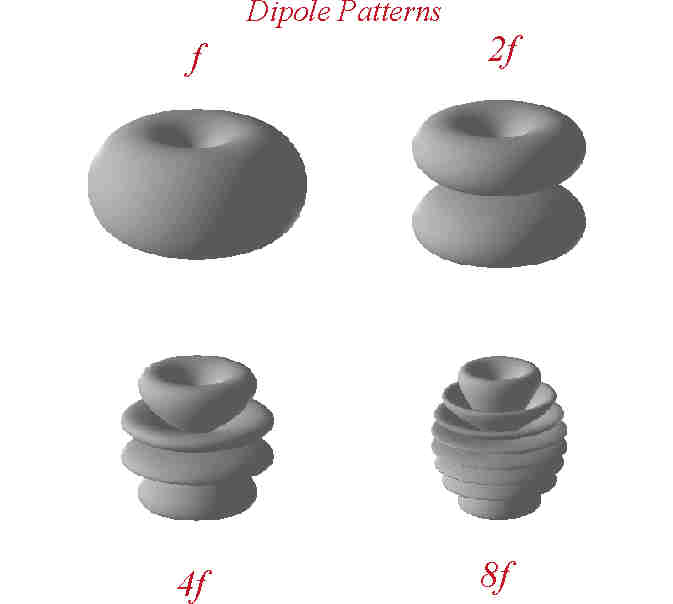 operating
wavelength ratio. This means that for a fixed antenna size, the main antenna
parameters (gain, input impedance, pattern shape and secondary lobe level and
distribution) will suffer strong variations when changing the operating frequency. For
instance, the picture on the right shows the evolution with frequency of the radiation
pattern of a classical common antenna (a linear dipole). Each time frequency is doubled,
several grating lobes appear, modifying the way the antenna spreads power into space.
operating
wavelength ratio. This means that for a fixed antenna size, the main antenna
parameters (gain, input impedance, pattern shape and secondary lobe level and
distribution) will suffer strong variations when changing the operating frequency. For
instance, the picture on the right shows the evolution with frequency of the radiation
pattern of a classical common antenna (a linear dipole). Each time frequency is doubled,
several grating lobes appear, modifying the way the antenna spreads power into space.
Analogously, the frequency dependence also implies that an antenna
has to keep a minimum size relative to wavelength to operate efficiently. That is,
given a particular frequency, the antenna can not be made arbitrarily small: it
usually has to keep a minimum size, typically on the order of a quarter wavelength.
These well known results have been constraining
for decades the antenna performance in telecommunication systems, and they have been the
object of an intensive research with some successful
results. However, the size to wavelength dependence is still a problem in many
systems where former antenna designs are not particularly suitable. In that sense,
the fractal design of antennas and arrays can help in dealing with the problem by
contributing with a huge, rich variety of geometrical shapes with some stonishing
properties. In this website the reader will find some examples of succesful designs of fractal
multiband and small antennas.
Fractalsare a whole
new set of geometrical objects featuring two main common properties: self-similarity
and fractional dimension. The first property is rather intuitive and readily comes
out from looking to a fractal object. Roughly speaking, an object is said to be self-similar
when it is enterely constructed by many copies of itself at different scales (see the
example on the left side of the page). On the other hand, the fractional dimensional
property is less intuitive but it can be explained by looking to the example of the
figure. 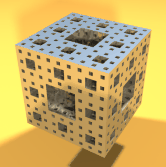 The construction of such a fractal shape (named
the Menger Sponge) starts from drilling a square hole on the center of each side of
a solid cube. The next step consists on drilling 8 new holes around the main one,
each of them being 3 times smaller than the original one. If that procedure
(burning 8 new holes around each one from the former stage) were carried out an infinite
number of times, the ideal self-similar fractal shape would be obtained. The ideal
object would contain an infinite number of copies of itself with a characteristic
scale factor of 3 relating the sizes of them all. Somehow, the intuition would tell us
that such an object is a 3D body, however the volume of the final shape after the
infinite drilling process vanishes. Nevertheless, the object seems to fill a 3D
space better than a simple 2D surface. Actually, it can be mathematically proved that
such an object has a dimension of D ~ 2.72, which means that is half-way
between a 3D and a 2D object. In other words, the object is a surface that
fills a 3D space better than any classical Euclidean surface.
The construction of such a fractal shape (named
the Menger Sponge) starts from drilling a square hole on the center of each side of
a solid cube. The next step consists on drilling 8 new holes around the main one,
each of them being 3 times smaller than the original one. If that procedure
(burning 8 new holes around each one from the former stage) were carried out an infinite
number of times, the ideal self-similar fractal shape would be obtained. The ideal
object would contain an infinite number of copies of itself with a characteristic
scale factor of 3 relating the sizes of them all. Somehow, the intuition would tell us
that such an object is a 3D body, however the volume of the final shape after the
infinite drilling process vanishes. Nevertheless, the object seems to fill a 3D
space better than a simple 2D surface. Actually, it can be mathematically proved that
such an object has a dimension of D ~ 2.72, which means that is half-way
between a 3D and a 2D object. In other words, the object is a surface that
fills a 3D space better than any classical Euclidean surface.
The reason why the fractal design of antennas appears
as an attractive way 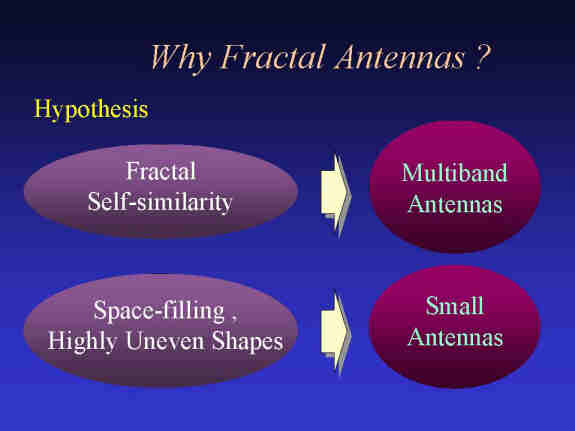 to make antennas is two-fold. First
because one should expect a self-similar antenna (which contains many copies of
itself at several scales) to operate in a similar way at several wavelengths. That
is, the antenna should keep similar radiation parameters through several bands. Second,
because the space-filling properties of some fractal shapes (the fractal
dimension) might allow fractally shaped small antennas to better take advantage of the
small surrounding space. Such basic concepts have been already confirmed by the examples
you will find here in the Fractal AntennasTM Gallery.
to make antennas is two-fold. First
because one should expect a self-similar antenna (which contains many copies of
itself at several scales) to operate in a similar way at several wavelengths. That
is, the antenna should keep similar radiation parameters through several bands. Second,
because the space-filling properties of some fractal shapes (the fractal
dimension) might allow fractally shaped small antennas to better take advantage of the
small surrounding space. Such basic concepts have been already confirmed by the examples
you will find here in the Fractal AntennasTM Gallery.
 (c) by Carles Puente
Baliarda, April 1998. For any comments please contact at
(c) by Carles Puente
Baliarda, April 1998. For any comments please contact at  webmaster