Task 1.1: Understanding fractal electrodynamics phenomena
Participating partners: |
UPC |
ROME |
EPFL |
Person-months: |
6 |
5 |
4 |
Understand better the behavior of electromagnetic fields and electric currents in fractal domains, in order to acquire guidelines for the design of fractal-shaped antennas and microwave devices. Specially the following issues will be addressed:
a) Pinpoint of mathematical bottlenecks: Formulation of electromagnetic scattering by fractal objects will require to re-elaborate a well established mathematical formulism. It is necessary to pinpoint at an early stage the key issues that must be addressed in connection to task 2.1.
b) Recursive analysis of IFS models: Iterated Function System theory is one of the most convenient ways to describe fractal objects and multifractal distributions. The analysis of IFS models for fractal sets provides the necessary formal background to approach integral equations in the presence of current distributions localized on fractal structures. The outputs to the other workpackages are particularly relevant for Task 2.2
On the Influence of Fractal Dimension and Topology on Radiation Efficiency and Quality Factor of Self-Resonant Pre-fractal Wire Monopoles
Preliminary studies on small pre-fractal antennas [Puente et al., “The Koch monopole: a small fractal antenna”, IEEE Trans. on Antennas and Propag., 48 (11), pp. 1773–1781] showed that fractal dimension might play a role in the radiation efficiency and quality factor of electrically small antennas. Its influence on the radiation pattern of small antennas is not of such importance because all electrically small monopoles have, essentially, the same radiation pattern. Nevertheless, until the work presented here no practical evidence has revealed a relation between fractal dimension and antenna parameters for self-resonant antennas.
The influence of fractal dimension on the behaviour of monopole antennas in terms of efficiency and quality factor has been investigated. Also, the role of the shape of pre-fractal monopoles with the same fractal dimension is analysed. This research has been carried out on 2D self-resonant pre-fractal wire monopoles and through the use of radiation efficiency and quality factor maps versus electrical size of the antennas at resonance.
The conclusions of this work are based on both measurements and simulations. It has been shown that manufacturing technology is able to fabricate highly iterated pre-fractal antennas and the preliminary measurements agree with simulated results for low-iteration pre-fractals.
Influence of fractal dimension:
Influence of radiation efficiency and quality factor on pre-fractal antennas has been analysed through the design of pre-fractal structures that in the limit converge to fractal curves of dimension 1.26 (Koch), 1.58 (Sierpinski Arrowhead) and 2 (Hilbert and Peano).
The simulation results show that increasing the number of pre-fractal iterations means a reduction on radiation efficiency and an increase on quality factor. The increase of fractal dimension, although making better space filling curves, builds larger monopoles with lower efficiencies and higher quality factors even for the first iterations.
Prototypes of the simulated structures have been printed on a fibreglass substrate with standard techniques used for the manufacturing of printed circuits for electronic boards. All of the monopoles are designed as self-resonant antennas, so they do not need any external load to cancel out the reactive part of their input impedance. Conclusions from the measurements of the printed antennas are nor different from simulations.
Influence of topology:
The influence of topology on the radiation efficiency and quality factor of small self-resonant pre-fractal wire monopoles with the same fractal dimension has been investigated. Several iterated function systems (IFS) could be used to design fractals with the same fractal dimension. So far, the consequence of changing the topology of a fractal without changing the fractal dimension of the curve has not been analysed before FractalComs project.
Several designs of Sierpinski antennas are simulated, all of them with fractal dimension 1.58 but having different IFS initiators and, therefore, different topology. Also, several designs of self-resonant wired pre-fractals with fractal dimension 2 are analysed: the Hilbert and 3 designs of the Peano curve have been used.
Results for both families of pre-fractals (fractal dimension 1.58 and 2) reveal the same behaviour when the shape of the fractal defines a long wire (like the Hilbert monopole, variants 2 and 3 of the Peano curve and the Sierpinski Arrowhead monopole): the increase on iteration means an increase on quality factor, a decrease on efficiency, and a reduction of the electrical size of the antenna at resonance. When the topology is defined by loops (delta and Y- wired Sierpinski monopole, and Peano monopole) the increase on iteration number means a reduction of quality factor, an increase in radiation efficiency and a trend to stagnation on a Euclidean structure (a rhombic monopole in the case of the Peano curves, or a triangular antenna in the case of the Sierpinski monopoles). Convergence to these limits is faster as the number of loops of the monopole structure increases.
The above structures have been not only simulated, but also fabricated as printed monopoles using conventional printed circuit techniques. The measured results show a reduction of η and an increase on Q when increasing the iteration and fractal dimension of large wire antennas. When pre-fractal structures include loops, larger radiation efficiencies and smaller quality factors are found with increasing fractal dimension and iteration. Nevertheless, high miniaturization is not easily achieved using pre-fractal loops. Quick stagnation of performances and trends to certain Euclidean structures (triangular and rhombic monopoles) are also observed in the measurements for these cases.
Conclusions:
The main conclusions from this work are:
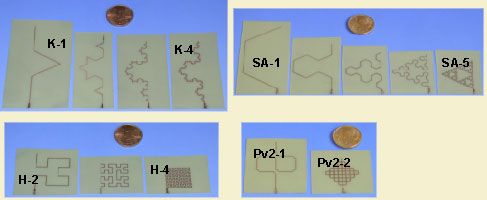
Figure 1. Printed monopoles used for the investigation on the influence of fractal dimension on radiation efficiency and quality factor. From left to right and top to bottom: Koch monopoles, Sierpinski Arrowhead monopoles, Hilbert monopoles and Peano variant 2 monopoles.
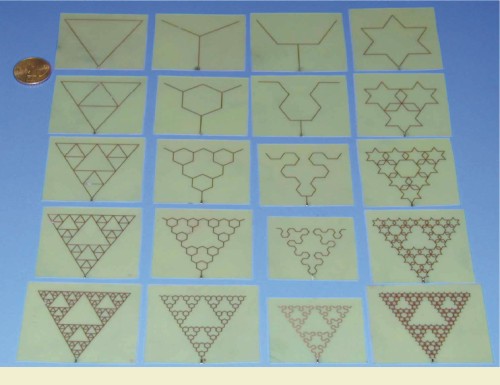
Figure 2. Manufactured prefractals with fractal dimension 1.58 compared with the size of 10 euro cents. From left to right and by columns: Delta-Wired Sierpinski monopoles (DWS); Y-Wired Sierpinski monopoles (YWS); Sierpinski Arrowhead monopoles (SA); and Koch-1 Sierpinski monopoles (K1S).
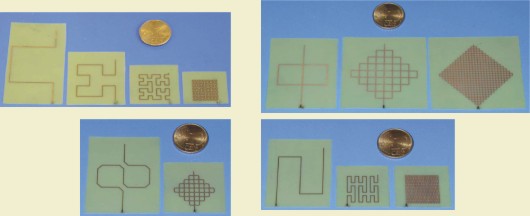
Figure 3. Manufactured prefractals with fractal dimension 2. From left to right and top to bottom: Hilbert monopoles (H); Peano monopoles (P); Peano variant 2 monopoles (Pv2) and Peano variant 3 monopoles (Pv3).
Study of 3D pre-fractals
The 3D Hilbert monopole has been modelled. Its performance in terms of efficiency, quality factor and electrical size at resonance has been simulated and, finally, the first three iterations of the pre-fractal have been manufactured with patience. Figure 4 shows the wire models analysed by the simulation software.
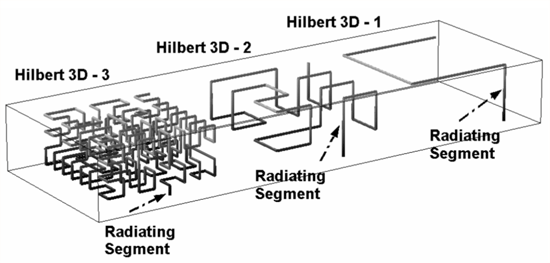
Figure 4. Simulated 3D Hilbert antennas in a monopole configuration. The first segment is the main contribution to radiation.
The computed current distribution along the wire suggests that
the first segment, connected to the feeder and perpendicular to the ground plane,
is the main source of radiation, while the rest of the antenna behaves as a
load.
Table I summarizes the computed parameters for these 3D models, showing that while the ratios of miniaturization are remarkable, the loss efficiencies and the quality factors achieved are unpractical. The extremely low value of the radiation resistance agrees with the hypothesis that only the feeding segment of the pre-fractal radiates as an electrically very small monopole, and the rest of the structure is a capacitive load that reduces the input reactance, and therefore, the resonant frequency.

Table I. Computed performance of the first three iterations of a 3D Hilbert monopole.
On the resonant frequency of pre-fractal miniature antennas
Wire antennas miniaturization is usually based in packing a long wire inside a small volume. The aim is to achieve the smallest antenna having a given resonant frequency or, equivalently, achieving the lowest resonant frequency of an antenna having a fixed size. It has been already shown that the resonant frequency of the Koch monopole decreases as the number of fractal iterations (K1, K2, K3...) increases. However, it has been found later that some non-fractal configurations that enclose a long wire into a finite volume also lead to a similar or better reduction in the resonant frequency, compared to the straight monopole having the same enclosing volume.
A close look at the results reveals that the resonant frequency of a Koch monopole is higher than that of a straight monopole of the same wire length and the reduction factor in the resonant frequency of the Koch antenna as the iteration number increases tends monotonically to one. This work investigates further in the dependence of the resonant frequency with the monopole geometry, in order to acquire guidelines for the design of self-resonant small antennas, in which an increase of the wire length effectively leads to a reduction in the resonant frequency.
Hipothesis:
The observed behavior is due to the coupling between sharp angles at curve segment junctions. These angles radiate a spherical wave with phase center at the vertex (Fig. 5). Each angle not only radiates, but also receives the signal radiated by other angles. As a consequence, part of the signal does not follow the wire path, but takes “shortcuts” that start at a radiating angle. The length of the path traveled by the signal is, therefore, shorter than the total wire length. The higher iteration number in the Koch antenna, the more angles it has and the closer to each other they are, so the more signal takes shortcuts and the less signal follows the whole curve path. This hypothesis has been verified by numerical simulations in the frequency and time domains (Fig. 6 and 7).
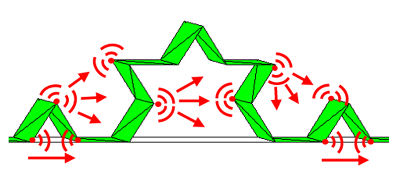
Fig. 5: Shorcuts
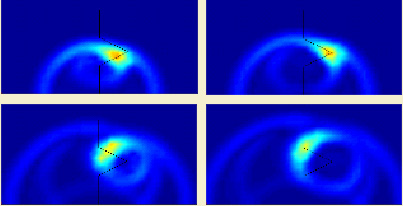
Figure 6: Near fields in the time domain in the vicinity of a single-iteration Koch monopole (K1) with short-pulse excitation. The sharp angles of the pre-fractal curve become the center of spherical wave radiation, which corroborates the coupling or shortcut effect hypothesis.
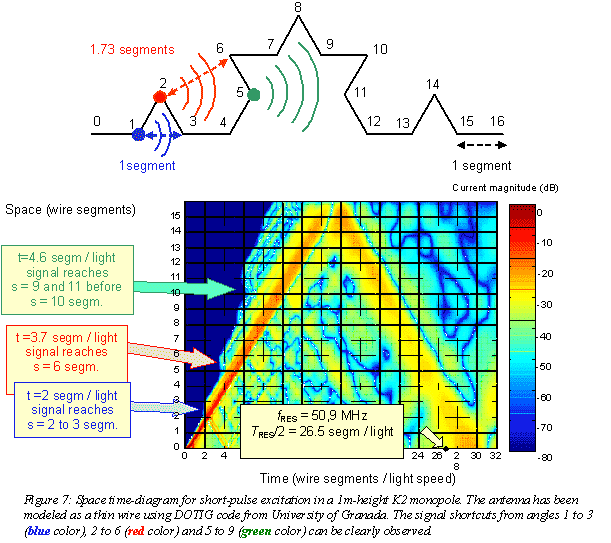
Numerical simulations in the frequency and time domains lead
to the following conclusions, that fully support the shortcut or coupling hypothesis:
Comparison with other pre-fractal and non-prefractal
monopoles:
The coupling or shortcut hypothesis is also valid for other kinds of pre-fractal or non-fractal miniature monopoles. Different kinds of miniature wire monopoles having the same wire length exhibit different length of signal leaps –or shortcuts- between wire angles, resulting in a different amount of coupling signal that takes the shortcut. For that reason, these antennas have different resonant frequency while having the same monopole height h and the same wire length.
Two pre-fractal monopoles of different fractal dimension in the limit and two non-fractal antennas have been analysed (Fig. 8). The generalized Koch and the wide zigzag configurations, for equal wire length, show longer signal leaps –or shortcuts- than the Koch or the narrow zigzag. The longer signal leaps, the less amount of coupling signal that takes the shortcut, the longer path followed by the signal and the lower resonant frequency.
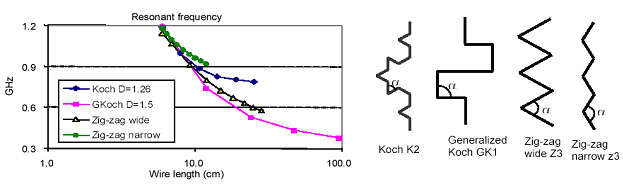
Figure 8: Resonant frequency as a function of the wire length. The antennas have been modeled as extrusion-strips of 1-mm width. Each marker in the plot corresponds to an IFS iteration in the pre-fractal geometries or the number of meanders in the zig-zags.
Benchmarks for pre-fractal antenna performance
In order to develop accurate numerical tools for pre-fractal antennas, well-defined non-fractal benchmarks must be first considered. Two Euclidean structures that have been found to posses properties that were considered exclusive of pre-fractal antennas are the meander printed line and the two-arm spiral.
High-gain localized modes: the meander line
The meander-line printed antenna has been carefully studied in order to see if it has high-gain localized modes, like the pre-fractal Koch-island patch, or not. The objective here is to assess if the localized modes are exclusive of pre-fractal structures, or not.
The meander antenna is a rectangular printed patch with N gaps of infinitesimal width parallel to two sides of the rectangle. The N gaps transform the rectangular patch in a line with N meanders.
The meander antenna has been compared with the original patch without the gaps:
Since localized modes have been known since the 60’s and outside the scope of fractal or pre-fractal structures, we can conclude that localized modes are not exclusive of pre-fractal antennas.
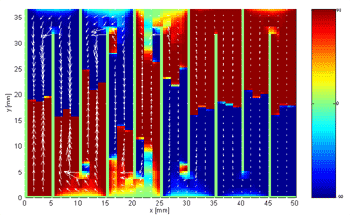
Fig. 9: Higher order mode at the printed meander line antenna. The colour scale shows the phase and the arrow length the magnitude of the imaginary part of the electric current.
Miniature antenna: The two-arm spiral.
A study of a two-arm square microstrip spiral antenna backed by a ground plane has been made (Fig. 10).
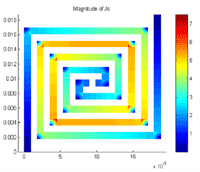
Fig. 10: Current magnitude at the first resonance of a four-turn two-arm spiral antena.
A spiral presents interesting properties from the geometric point of view, namely self-similarity and infinite length in a finite surface, properties shared by fractal objects. Having chosen a polygonal spiral rather than a Archimedean one is due to the fact that polygonal spiral fits better in a given surface, achieving a more efficient utilization of given area, a principle to take into account when miniaturizing antennas.
Taking as working surface a square of side SL=1.875cm, different iterations of a spiral have been studied and compared with two straight dipole configurations: the dipole of length equal to the unwrapped spiral length and the longer dipole that would fit in the reference square, having as length the diagonal of the square.
Table II shows that the spiral antenna has a resonant frequency almost as low as the straight dipole of same wire length. According to the guidelines derived from the shortcuts or couplings study in preceding section, this is due to the weak electromagnetic coupling between angles, between the feeder and the strip or between parallel strip segments with opposite current. Unlike pre-fractal antennas, the resonant frequency scales almost linearly with the inverse of strip length while keeping the wire enclosed by a small square.
- |
Resonant freq. [GHz] |
Spiral 4-turns |
1.77 |
Straight dipole unwrapped spiral |
1.6 |
Straight dipole diagonal |
11.6 |
Table II: Resonant frequency of a 4-turn two-arm spiral, the straight monopole of equal length and the longer monopole that would fit in the reference square
The spiral antenna constitutes a very good benchmark to judge
pre-fractal antennas as provides a tough challenge offering excellent miniaturization
while keeping a reasonable frequency behaviour.
Task conclusions and design guidelines
Guidelines for the design of miniature monopoles
As a conclusion of the work in this task and very recent work available in the literature, the following guidelines can established for the design of miniature wire antennas:
An example of wire antenna that closely follows these guidelines is a two-arm spiral. The resonant frequency of a square spiral is inversely proportional to the wire length, while keeping the wire enclosed by a small square.