Task 3.1: Advanced meshing of fractal structures
Participating partners: |
UPC |
EPFL |
CIMNE |
Person-months: |
3 |
3 |
20 |
Antennas numerical simulation is most often based on the Electric Field Integral Equation (EFIE) discretized by Method of Moments (MoM) using conventional triangle or rectangle mesh discretizations. This approach imposes the following main limitations:
On the other hand, Boundary Element Methods (BEM) lack of some of the difficulties above, but unfortunately they cannot be used with the EFIE.
To overcome these difficulties:
a) A high-order point-based discretization scheme based on Nystrom method with singular kernel correction will be explored (UPC, EPFL).
b) Advanced adaptive meshing facilities will be developed for fractal domains (CIMNE). In a first phase, conventional meshing algorithms will be adapted to the requirements of the present project. In a second phase, the production of fractal meshes for the discretization of fractal domains will be evaluated and, if possible, the corresponding algorithms will be developed and coded.
c) New basis functiosn for vertex-connected structures will be introduced (EPFL).
d) Specific treatment of T-junctions and similar complex connections will be provided (EPFL).
Nystrom method high-order discretization scheme
Formulation and software code has been developed for the analysis of electrostatic problems with potential equation and Nystrom method. The kernel singularity has been corrected by Strain’s method, using polynomial testing functions. The charge is therefore represented by a underlying polynomial basis. The results for objects with open surfaces are very bad, since the charge is singular at edges and cannot be expanded by the underlying polynomial quadrature basis. On the contrary, when the unknown charge is a polynomial, Nystrom method gives very small errors, up to machine precision.
Close form formulas for evaluating the integrals that arise in the computation of Strain correction have been derived for problems with singular kernel and polynomial unknown. However, it has not been possible to derive Strain correction formulas for problems having both singular kernel and unknown. Problems of this kind are the Electric Field Integral Equation (EFIE) and the electrostatic potential equation on open surfaces. For that reason, Nystrom method can be currently applied to electromagnetic problems only on closed surfaced, which is not the case of the antennas under consideration.
For those reasons, Nystrom method is not adequate for the analysis of pre-fractal antennas, since:
On the other hand, since the integrals of the current or charge along pre-fractal antennas converge very fast with the number of iterations (result of WP2 and Task 3.2), then it is possible to discretize the EFIE in highly-iterated pre-fractals using the conventional Galërkin - Method of Moments, which is in essence a weighted residual procedure.
In conclusion, we think that the Method of Moments with Galërkin testing (weak formulation) is the most robust approach to discretize the EFIE in pre-fractals. This assumption has been corroborated by the excellent results of numerical simulations in tasks 3.2, 3.3 and 3.4.
Modeling pre-fractal antennas
Modeling highly-iterated pre-fractal wire antennas is a challenging problem. It has been shown in [Deliverable D6, Task 3.2 Final Report] that several difficulties arise with Pocklington integral equation and thin-wire models, even with the extended kernel.
The possibility of modeling the wire cylindrical surface with a triangle mesh is not practical do to cylinder intersections at corners, the huge computational cost required and, in difficult problems, there is no convergence with mesh refinement.
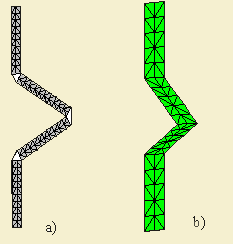
For that reason, we propose here to model pre-fractal wires using a narrow strip. Two strip models are considered: the planar and the extrusion strip (Fig. 18). Both lead to similar results for low-iteration pre-fractals, but the extrusion strip, unlike the planar one, can model highly-iterated pre-fractals in which the strip width is comparable to the pre-fractal segment length (Fig. 19).
|
Figure 18: Koch pre-fractal monopole of 1 iteration modeled as planar strip (a) and an extrusion strip (b). |
For both kinds of strips, the discretization in triangles of size much smaller than the wavelength makes the linear system very badly-conditioned. For that reason, iterative solvers fail, even with huge pre-conditioners. A direct solver can be used with more than 10,000 unknowns thanks to the block-solution algorithm developed at UPC.
A numerical integration and mesh refinement convergence study has been done. The extrusion strip model shows good convergence with both refinement of mesh size and refinement of EFIE source and testing integration, for both the cases of electrically very small and self-resonant antennas.
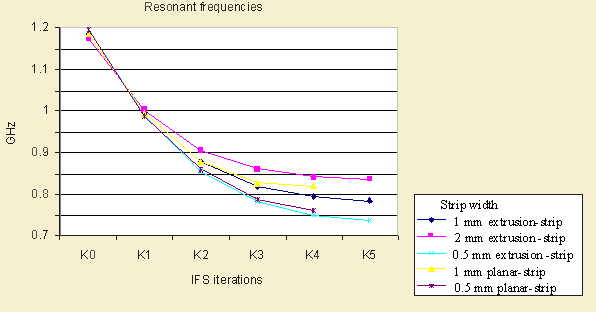
Figure 19:Resonant frequency of 6cm-height Koch monopoles made of planar and extrusion strips of different widths. The planar models depart from the expected pre-fractal behaviour when the number of IFS iterations increases.
Meshing pre-fractal antennas
Software facilities have been developed in order to mesh a wide range of fractal geometries in the most automatic and adaptive way with while keeping the user interaction to a minimum.
The starting point of this task is the commercial pre and post-processing software package named GiD that has been developed at CIMNE. This software has been developed for giving support to all the necessary operations for the preparation of data for numerical analysis involving any type of geometrical discretization of the analysis domain, like in the case of the numerical algorithms used in the FRACTALCOMS project. Since standard CAD systems are not prepared for the generation of fractal geometries, the main activity in Task 3.1 has consisted in providing GiD with new software facilities for the automatic generation and meshing of fractal geometries. In addition, special adaptive mesh facilities have been added to the software in order to allow an enhancing of the quality of the numerical results in certain areas of the analysis domain.
The main technical aspect of the new tools added to GiD for the generation and meshing of fractal geometries is the recursive definition of the fractal geometry. Following the indications from UPC, this definition is based in the use of a geometrical Initiator and a geometrical Generator. The generation of the fractal geometry is based on a recursive process in which each segment of the Initiator is substituted by the Generator. Both the Initiator and the Generator can be selected from an existing list or manually defined by the user (Fig. 20).
If the thin-wire approximation is not used, the recursive definition of the fractal geometry produces a wire antenna that needs to be widened in order to get a strip. This process is produced by widening each linear segment of the obtained geometry. Special care has to be taken in order to avoid overlapping between strips from consecutive segments at the corner points. This process is executed automatically after defining the with of the strip antenna.
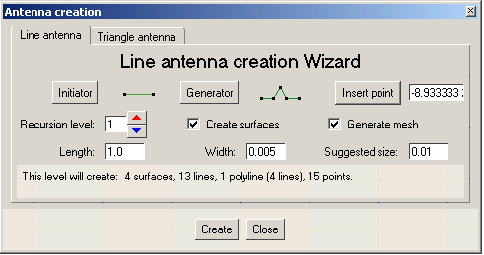
Fig. 20: The simple pre-fractal curve creation utility developed in the first year of the project.
The next step is the generation of the mesh for the numerical
analysis of the fractal antenna. This process is performed in a completely automatic
way after defining the size and the type (triangular or quadrilateral) of the
elements. In addition, it is also possible to generate adapted meshes with a
non uniform distribution of sizes after some manual definition of the desired
size at each part of the domain (Fig. 21).
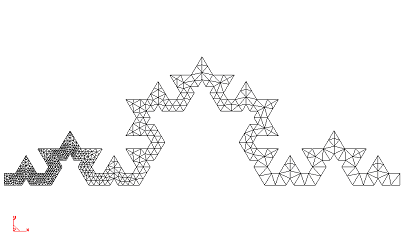
Fig. 21: Adaptive meshing of a Koch antenna created with the software utility shown in Fig. 20.
During the first year of the project an increasing interest
in antennas created from networked MRCM fractal geometries was detected. This
suggested to enlarge the software capabilities developed during the first year
in order to deal with this alternative type of geometries. Even taking into
account that Task 3.1 finished at T0+12, CIMNE agreed in being active for the
second year in order to allow for the mentioned software improvements. The expansion
of CIMNE activity was carried out using some remaining man months that had not
been completely consumed during the first year project.
During the second year of the project GiD has been provided with a new module in order to generate MRCM fractal geometries (Fig. 22 and 23). A networked MRCM is defined by three components: the initial images, the set of transformations and the machines definitions.
An initial image is a line, or polyline, of straight segments; each transformation is defined as an affine transformation, a combination of scale, rotation and translations; and a machine is the application of the transformations to the images. Every machine produces its own image, operating not only on its own image, but also on all images of the other machines in the network. Here we also call ‘generators’ to the machines.
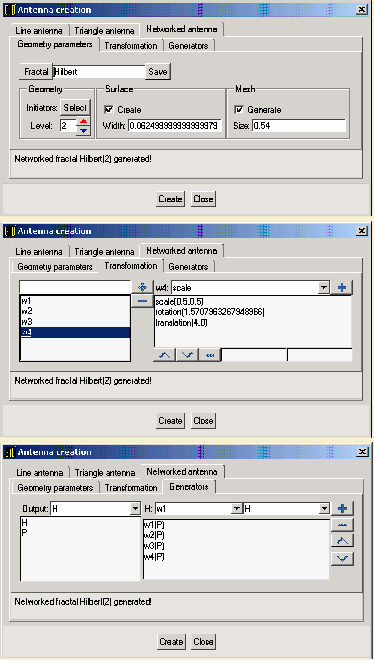
Figure 22: Software utility to create networked MRCM pre-fractal geometries.
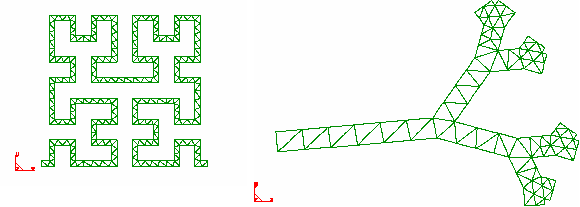
Figure 23: Two examples of networked MRCM pre-fractal antennas created and meshed with the new GiD module: Hilbert (left) and Twig (right) antennas.
New basis functions
EPFL partner has developed a new set of basis functions defined on quadrangular regions (see example in Fig. 24). Particular cases of these functions are the well-known rooftop and Rao, Wilton and Glisson (RWG) basis.
These new functions will be very useful for the project because they simplify enormously the electric connection between different patches of the pre-fractal that share only one vertex. As a result, it will be easier to build adaptive meshes having less unknowns and modeling better the variation of the current in the pre-fractal geometry.
Three cases of quadrangular basis functions have been considered:
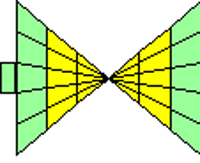 |
Figure 24: Bow-tie antenna meshed with quadrangular basis functions. |
The best results are obtained with the 3rd option. The agreement
with the conventional rooftop and RWG functions is very good.
The potential of quadrangular basis functions for solving connectivity problems has been shown in the simulation of a bow-tie antenna with different feeding zone sizes. The results are very promising.
Treatment of T-junctions
When building prefractal antennas of intricate shape (Koch, fractal tree) with microstrip or printed technology, discontinuities such as right-angle bends, T-junctions and crossings are encountered. In a boundary element discretisation, brute force approach would require an important computer effort and time for such complicated structures and would prevent us to analyse but the very first fractal iterations. Knowing the electromagnetic behaviour of these connections (mainly the distribution of currents and charges), a model could be created in order to substitute a brute force discretisation in the junctions. In the present work, a study of currents and charges in a T-junction is done in order to know which kind of global basis function would serve best as model for this type of junctions. This global basis should allow us to analyse pre-fractal antennas up to the iteration limit imposed by current technology.
Different models for analysing printed junctions have been discussed. First, the quasistatic model has led us to two results, namely: The current distribution tends to be solenoidal at low frequencies and Kirchoff’s law should be satisfied in small junctions. Then a transmission line (TL) model has been studied to have some useful global indications about the charge and current behaviour. In this case Kirchoff’s law must still be satisfied but opposite to quasistatic approaches, the TL model allows prediction of charge behaviour in the arms connected at the junction. Indeed the TL predictions are frequently a good approximation at the global level.
These global results have been corroborated with a full-wave model. For low frequencies the general behaviour of charge and current along the line for the transmission line model and in the full-wave model is the same, except, of course, in the junction. For high frequencies radiation phenomena take place, and so transmission line model is no longer valid. But even at low frequencies, radiation is generated at the junction. This results in a net decrease of charge level at the junction which has been systematically observed in our numerical experiments. This feature of the charge must be included in the pre-fractal antenna model if accurate predictions are required.
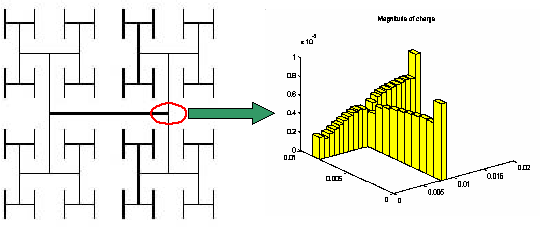
Fig. 25: Magnitude of charge in a T junction of a H-tree pre-fractal antenna.
With the full-wave model the structure has been studied once with a rough mesh and once with a very high number of unknowns, to know in detail which is the evolution of currents and charges on the T-junction, for different kind of excitation. With a high degree of detail results show with precision the zones where current and charge maxima or minima can be found. For low frequencies, in the junction and without taking into account singularities, the charge can be said to be constant, but it is no longer the case for high frequencies. All this information must be used in order to define a global basis function that reproduces these characteristics, and thus it can be used to substitute the detailed fine mesh in the junction without loss in precision and accuracy of results.
Summarizing, this study has set up the basic strategy for the modelling of connections and junctions in pre-fractal antennas. Some observed effects deserve further study in order to reach a correct interpretation. For instance the electromagnetic behaviour of junctions seems to depend critically on the kind and type of excitation.
At a first glance, this seems to render hopeless a global, unique approach for junctions in fractals. But save for the case of a junction containing eventually the excitation, most junctions in fractal structures are essentially excited by the fractal itself and hence there is room for a systematic time-saving treatment.